

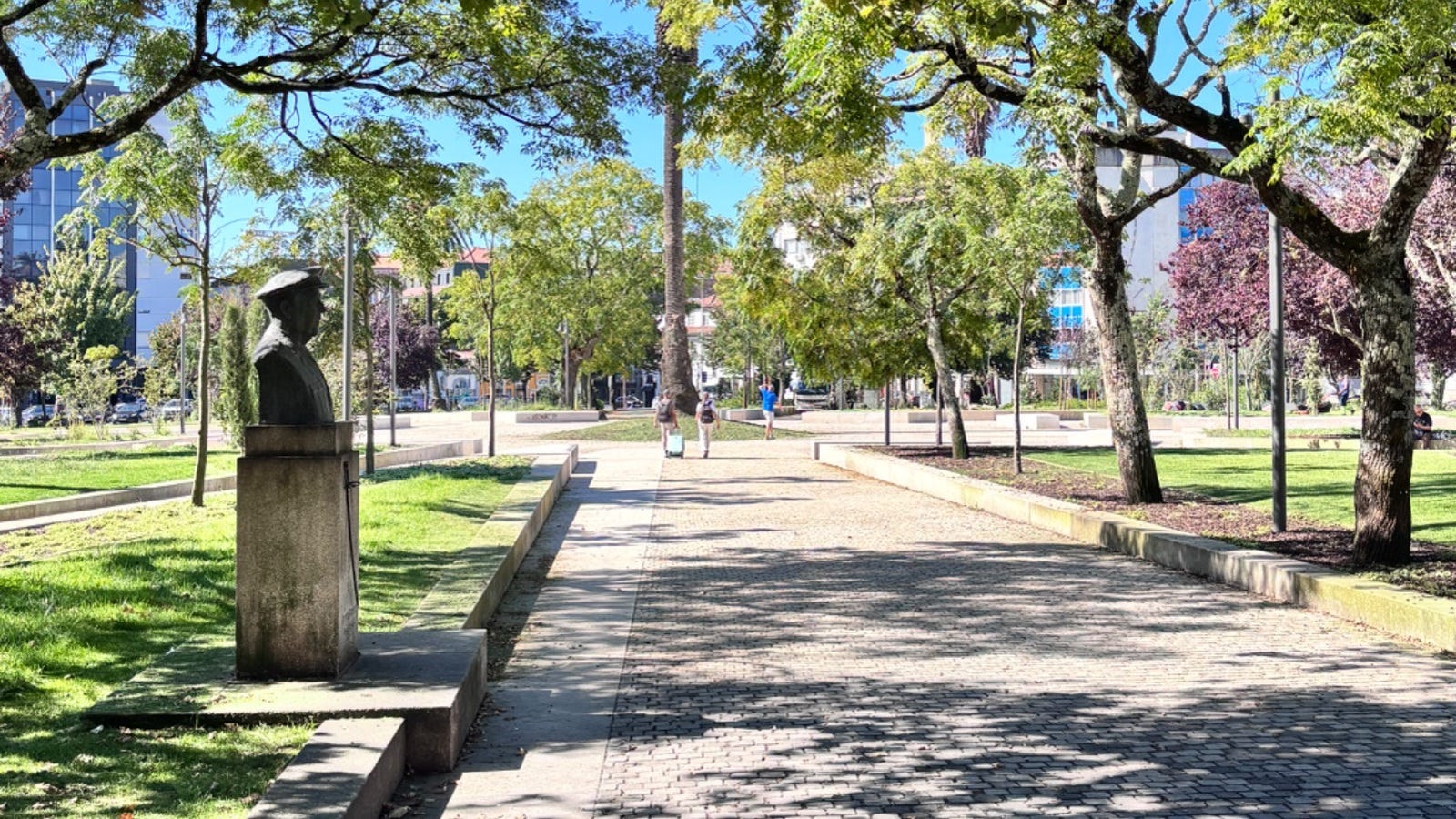
Every day I have the choice of right or left.
I leave the door of my house to a street with the slant of a one-sided teeter-totter.
Parks in each direction. Each way the walk is utilized, not wasted.
The destination is a place to take a moment in some green space.
To be present.
To slow everything down.
Eliminate the distractions and focus on observation and thought.
Jotting down thoughts, processing what crazy things appear in my brain.
Time for me.
I walk there with something to think about.
Or not.
Some days I’m just looking to see the changes.
A new building permit.
A new neighbor or an acknowledgement of the one you see each time.
Each direction is about 15 minutes.
No car, just steps.
Nothing but thinking extracted from the habit of moving.
The decision to choose Porto was an easy one.
My wife and I had a goal to live somewhere where we could live without a car.
So we both sold ours before moving here.
I didn’t fully appreciate what that decision would do until we were living it.
I didn’t have to schedule walking. It became the easiest way to get somewhere.
The environment was creating the behavior.
Designed Success
That made me realize you don’t have to move to another country to do the same thing.
You can change your environment even in small ways to make the behavior you want easier to repeat.
For years, my environment had worked in the opposite direction.
The demands of hospitality slowly pushed most of my healthy routines aside.
Yoga was the one healthy habit that survived the demands of my career.
It forced me to go to the class I signed up for and couldn’t cancel.
No phones were allowed. I had to be focused and present.
I got a full-body workout, became more flexible, improved my mental focus, and saw the progression.
Most importantly, I kept showing up.
What I Wanted to Preserve
As I studied how to correct my sleep and diet, I also had a suspicion that something was missing.
I began wondering whether yoga was enough for the future I wanted.
I want to be strong into my 90s. I want to thrive and be capable.
The goals I wrote down were strength, flexibility, lean mass, and physical independence.
I started to think about what I wanted my body to still be able to do decades from now.
Getting off the floor by myself.
Carrying my own things.
Taking the stairs.
Traveling.
Dancing with my wife!
The Missing Piece
The goals I wrote down led me to incorporate strength and resistance training.
I kept reading about muscle loss that can begin in our 30s, for both women and men.
This fact is pretty sobering and made me observe people as they were aging.
The way they carried themselves, their posture, their gait.
It was profound that their strength and activity were playing a major role in their quality of life.
Life quality is the thing I want to preserve and improve.
How do I change the math in my favor each decade?
Resistance training is a huge part of this.
One remarkable study followed men and women for nearly five decades. Different measures of physical capacity peaked at different points between 19 and 36. Decline followed, accelerating after about 40.1
Age-related losses in muscle strength and mass can eventually become sarcopenia, a muscle disorder involving diminished muscle strength, quantity, and physical performance.2
One widely cited estimate places average decline in muscle mass between 3–8% per decade after 30, with losses accelerating after age 60.3
This is not a foregone conclusion.
The people who became more active later in that long-running study were still able to improve their capacity.4
Resistance training gives the body a reason to preserve muscle and, in many instances, build more.5
Losses in muscle strength and physical capacity are associated with falls, disability, and the loss of independence.6
Already 65… start.
35 and never worked out? Start.
It’s not too late.
How I Train
I decided to train two to four times a week plus daily walks.
I break it down into a day each of the upper and lower body.
Then I add a third workout: core and cardio.
If I can add the fourth day, I usually focus on certain muscles and maintenance.
I used this as my original base, and now change it based on how I feel and use the extra workouts for testing new routine additions.
The mind-body connection was the most powerful thought from yoga, and I apply it to my workouts.
When training, I focus on the muscles that I am trying to strengthen. It helps me stay deliberate during each repetition.
Try it.
I don’t focus on my aesthetics. I focus on getting stronger.
The focus is full-body strength and balance.
The intent of this focus is to build for the future I want.
Chasing definition and looks seems shortsighted.
But we all want to look good. Look better.
Me too.
Consistency Is My Superpower
Even one resistance-training session a week can produce benefits.7
More may produce greater results, but one is still more than none.
I saw a problem from a human-nature standpoint.
Something done once a week seems very easy to forget or discontinue.
I always look at ways to stay consistent.
Continually showing up for something over time has a hidden power to it.
Consistency beats a perfect routine every time.
Showing up for yoga classes taught me about the compounding benefits.
When consistency starts to show progress, you become more dedicated.
So I applied this to resistance training.
Walking Still Matters
10,000 steps a day? I just started walking more.
I care less about hitting an exact number than finding reasons to move throughout the day.
Sometimes those reasons can be useful on their own.
A 20-minute walk can reduce the rise in glucose after a meal compared to remaining seated. 8
Most importantly, don’t beat yourself up over a sub-10,000-step day.
Try this exercise.
Watch older people around you. Who do you want to be when you grow up?
I want to be the lady that is more spry than her oldest daughter. The one that gets mistaken for her sister.
The 85-year-old that runs in the park every day.
Walking is natural to life. It just needs to be prioritized and incorporated.
It’s easy. Just put the phone down.
If you can’t do that, listen to something while you do it.
Unless it’s pouring or 90°F+ (32°C+), I’d rather walk than take any other transport.
Find a way to make walking a part of your day. If you don’t think about it, it won’t happen.
Don’t build in an excuse, build a workaround.
Choose Something You Will Keep Doing
Stop thinking and start doing.
Give yourself permission to do less than you think is needed.
Just be consistent.
Walking. Yoga. Lifting. Dancing.
Anything you will keep showing up for. This is the most important part.
Enjoy it and you will continue.
Yoga helped me to inhabit my body, not just use it.
You don’t need to do yoga, but pay attention to how you feel.
Start thinking about it when you are walking. Focus when you lift and see the difference.
Especially when something is not right.
When it isn’t, listen. Don’t push.
For me, resistance training was the missing piece.
It is the down payment on the life I want in the future.
There are not many times in life when you can see the future.
This is one of them.
What kind of movement can you keep showing up for?
Tell me in the comments. If this made you think of someone who has been waiting for permission to start smaller, restack it or send it to them.
Live well,
Nathan
Educational only — not medical advice. Consult your physician before changing your health, diet, or exercise routine.
Sources
Westerståhl M, Jörnåker G, Jansson E, et al. “Rise and Fall of Physical Capacity in a General Population: A 47-Year Longitudinal Study.” Journal of Cachexia, Sarcopenia and Muscle. 2025;16(6):e70134. https://doi.org/10.1002/jcsm.70134
Cruz-Jentoft AJ, Bahat G, Bauer J, et al. “Sarcopenia: Revised European Consensus on Definition and Diagnosis.” Age and Ageing. 2019;48(1):16–31. https://doi.org/10.1093/ageing/afy169
Volpi E, Nazemi R, Fujita S. “Muscle Tissue Changes With Aging.” Current Opinion in Clinical Nutrition and Metabolic Care. 2004;7(4):405–410. https://doi.org/10.1097/01.mco.0000134362.76653.b2
Westerståhl M, Jörnåker G, Jansson E, et al. “Rise and Fall of Physical Capacity in a General Population: A 47-Year Longitudinal Study.” Journal of Cachexia, Sarcopenia and Muscle. 2025;16(6):e70134. https://doi.org/10.1002/jcsm.70134
Currier BS, McLeod JC, Banfield L, et al. “Resistance Training Prescription for Muscle Strength and Hypertrophy in Healthy Adults: A Systematic Review and Bayesian Network Meta-analysis.” British Journal of Sports Medicine.2023;57(18):1211–1220. https://doi.org/10.1136/bjsports-2023-106807
Cruz-Jentoft AJ, Bahat G, Bauer J, et al. “Sarcopenia: Revised European Consensus on Definition and Diagnosis.” Age and Ageing. 2019;48(1):16–31. https://doi.org/10.1093/ageing/afy169
Taaffe DR, Duret C, Wheeler S, Marcus R. “Once-Weekly Resistance Exercise Improves Muscle Strength and Neuromuscular Performance in Older Adults.” Journal of the American Geriatrics Society. 1999;47(10):1208–1214. https://doi.org/10.1111/j.1532-5415.1999.tb05201.x
Engeroff T, Groneberg DA, Wilke J. “After Dinner Rest a While, After Supper Walk a Mile? A Systematic Review with Meta-analysis on the Acute Postprandial Glycemic Response to Exercise Before and After Meal Ingestion in Healthy Subjects and Patients with Impaired Glucose Tolerance.” Sports Medicine. 2023;53(4):849–869. https://doi.org/10.1007/s40279-022-01808-7