

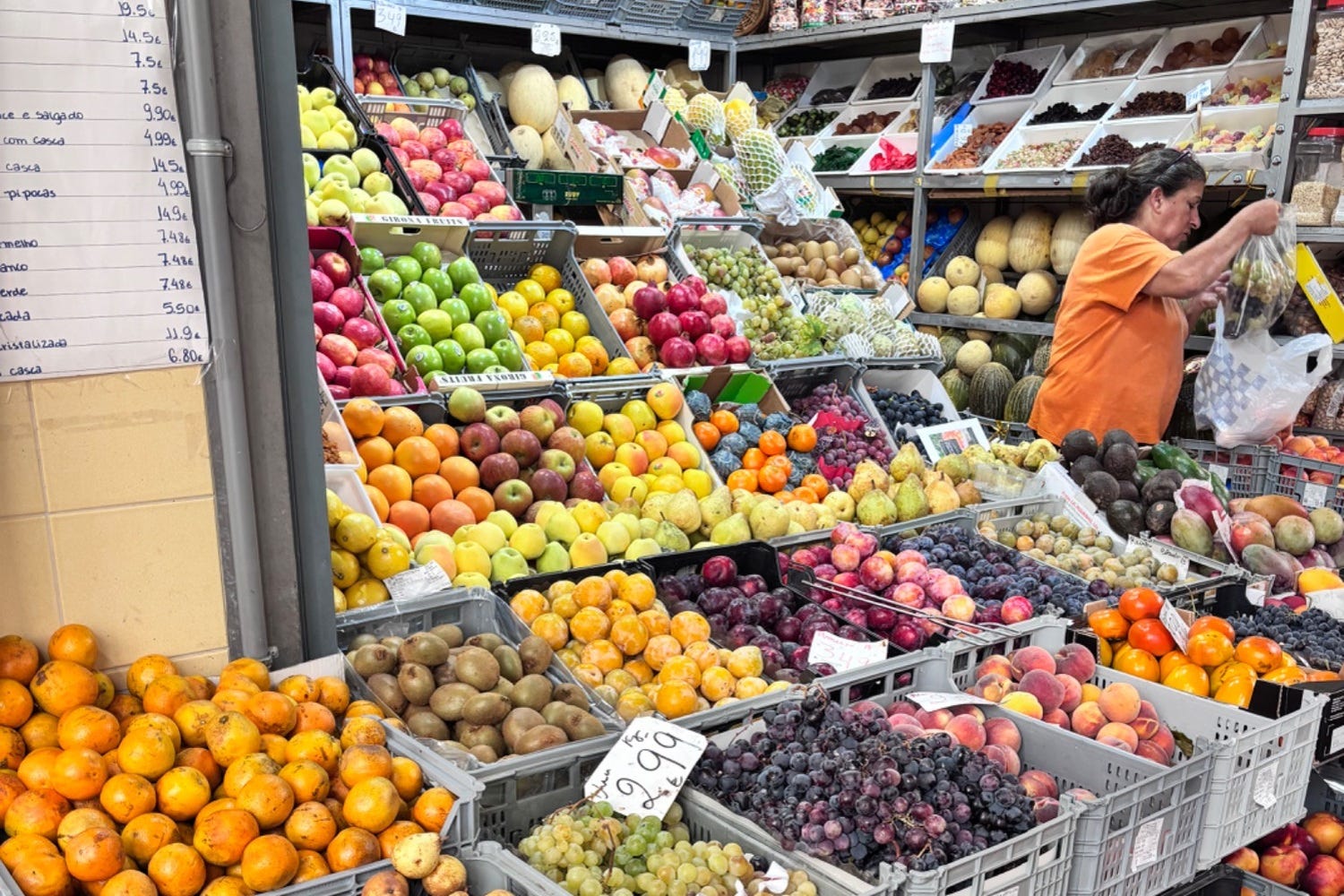
In California summer, the produce seemed as endless as the sunshine.
The corn and tomatoes showed up, and then all stone fruits.
So many strawberries you wondered how they would ever sell them all.
Every supermarket.
You thought they would have them for months.
Unless you bought it from a farmer’s stand, what you didn’t know is where it was from.
In Portugal, the seasons hit like lightning. Out of nowhere.
Giant imperfect tomatoes. Multiple varieties of plums.
Figs overflow storefronts.
‘Nacional,’ from Portugal.
The smell of
melons hits you before you enter the market.
Each time you eat something here, you wish you had picked up a few more.
If you are lucky, you get one more time to buy them.
As fast as they appear, they vanish like a college friend at a party.
In Portugal, I started noticing fruit varieties and region names I hadn’t paid attention to in California.
Pingo de mel, coração de boi, ameixas, pêssegos, melões, chapéu do bispo.
I made notes for next year’s window.
Maybe the endless summer of fruits and vegetables in California was lengthened by several other regions taking turns.
When we call food seasonal, whose season are we really describing?
In Part 1, I looked at fresh, frozen, stored and imported produce.
This time, I wanted to understand what “in season” actually tells you.
This is the second article in a four-part series about seasonal eating:
Part 1: Whether fresh, frozen, stored or imported is best.
Part 2: What “in season” means in a global food system. (You’re here.)
Part 3: Whether seasonal produce is actually more nutritious.
Part 4: How much seasonality should influence what we buy and eat.
Part 3 tests whether seasonal food actually has more nutrients.
Subscribe free and I’ll send it to you.
Two Meanings of Seasonal
In 2021, a systematic review by Vargas and colleagues looked at how researchers define seasonal food.
It reviewed 116 articles, 34 of them addressed or referenced seasonality, but only 6 made it central.1
The clearest line I’ve found comes from a 2012 report for DEFRA, the UK’s environmental department.
It was written for Britain, but its terms work anywhere. These definitions are relative to where the food is grown and eaten.
Globally seasonal: grown outdoors in its natural season where it’s produced, but may be shipped and eaten anywhere.
Locally seasonal: grown and eaten in the same climate zone without high-energy climate control or storage.
Adapted from DEFRA (2012), as reproduced in Macdiarmid (2014).2
These are research definitions and not labeling rules themselves.
Both sources come from sustainability research. I’m borrowing their definitions, not the environmental arguments. That's a separate question from the one this series asks.
What we are interested in is where and when the harvest happens.
Ameixa d’Elvas, the DOP protected name for the Rainha Cláudia Verde plum variety, is grown in Southern Portugal.
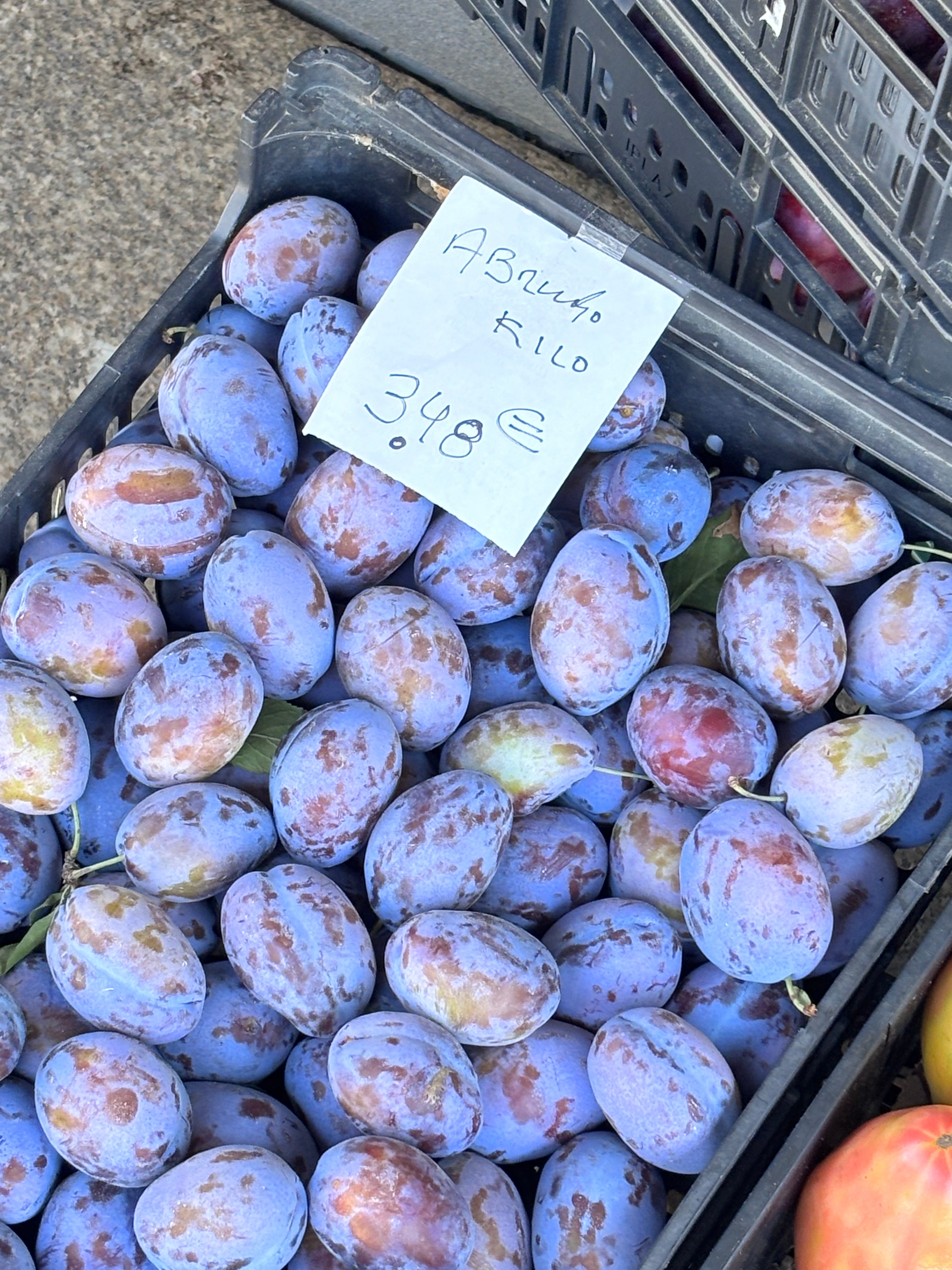
It is grown in the Évora and Portalegre districts and known locally as ‘abrunho.’ 3
The name and DOP let you know two things. Variety and origin.
The harvest window comes with the tradition.
Timing of a yearly harvest is affected by: temperature and frost, daylight, rainfall, variety and planting date.
The calendar counts days. Plants respond to temperature.
In one Oregon State example, the same broccoli variety grown in the same place took anywhere from 66 to 103 days to mature, depending on when it was planted.4
A calendar is our guide, not a promise.
The calendar is not wrong. The shifted harvest just means it’s a different year.
Whose Season Is It?
Plum season in South Africa runs from November to May.
The stone fruit peaks in late January to early February.5
A February plum in Lisbon can be fully in season, in South Africa.
Harvests get stitched together to provide a near year-round supply.
I remember this growing up in California.
This is why certain staples almost never disappear from your supermarket.
The Greenhouse Effect
Greenhouses have changed when food is grown.
Here’s a quick breakdown of three greenhouse systems and the produce growing windows:
Greenhouse types:
A plastic tunnel - shelters plants and nudges the season
Heated greenhouse - adds energy needed to help grow
Heated and lit - supplements winter light as well as providing heat
Growing windows:
Regional outdoor window - growing season determined and set by weather
Extended Commercial window - set by structures, energy and demand
A 2020 publication estimated that Portugal has about 3,000 hectares of greenhouses.
Plastic tunnels have been the main choice, and tomatoes the most important greenhouse crop.
These greenhouse “tunnels” move tomato growing undercover and soften the weather’s grip.6
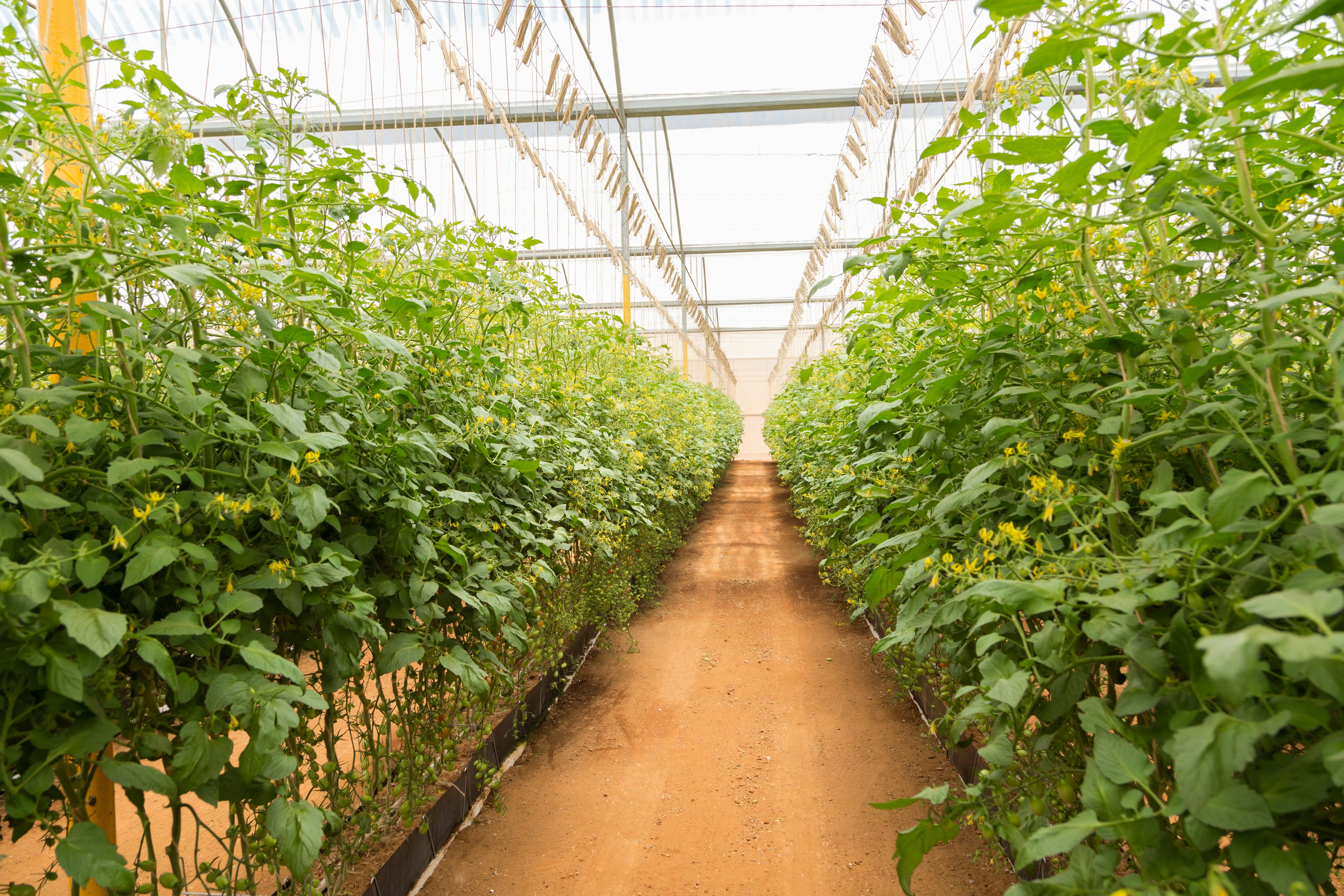
These tomatoes can be labeled Nacional on a shelf in Lisbon and Porto and come from a tunnel.
They’re local, but can be picked outside the outdoor season.
Is this still seasonal?
In 2023, imports accounted for an estimated 88 percent of U.S. greenhouse tomato supply, according to the USDA.7
Imports traditionally helped to fill the American off-season.
Greenhouses are changing that.8 A noticeable change is the availability of tomatoes, especially in the cherry and grape varieties.
In 2023, the USDA estimated almost eighty percent of imported cherry and grape tomatoes are greenhouse grown.
A greenhouse extends more than just the local season. It blurs the global one.
A Mexican greenhouse tomato in July isn’t filling an American off-season. It can compete with American field tomatoes during their growing season.
Then What Is It Called?
You see a Portuguese tomato on the shelf in May.
“Nacional” tells you its country of origin.
It means Portuguese-grown. That’s what I mean by local here, not necessarily grown nearby.
May tells you when you’re buying it.
Neither tells you its growing region or harvest date.
There is no certainty whether it came from an open field, tunnel, or heated greenhouse.
You lack enough information to apply seasonal definitions confidently.
That is something the label doesn’t tell you.
The definitions run out before the tomatoes do.
That isn’t judgement. It’s neutral.
The tomato shows three words, all doing different jobs.
It’s local.
It’s on the shelf.
Its seasonality is unclear.
The tomato isn’t confusing, but the words are.
Standing in front of that tomato, I am really asking three separate questions.
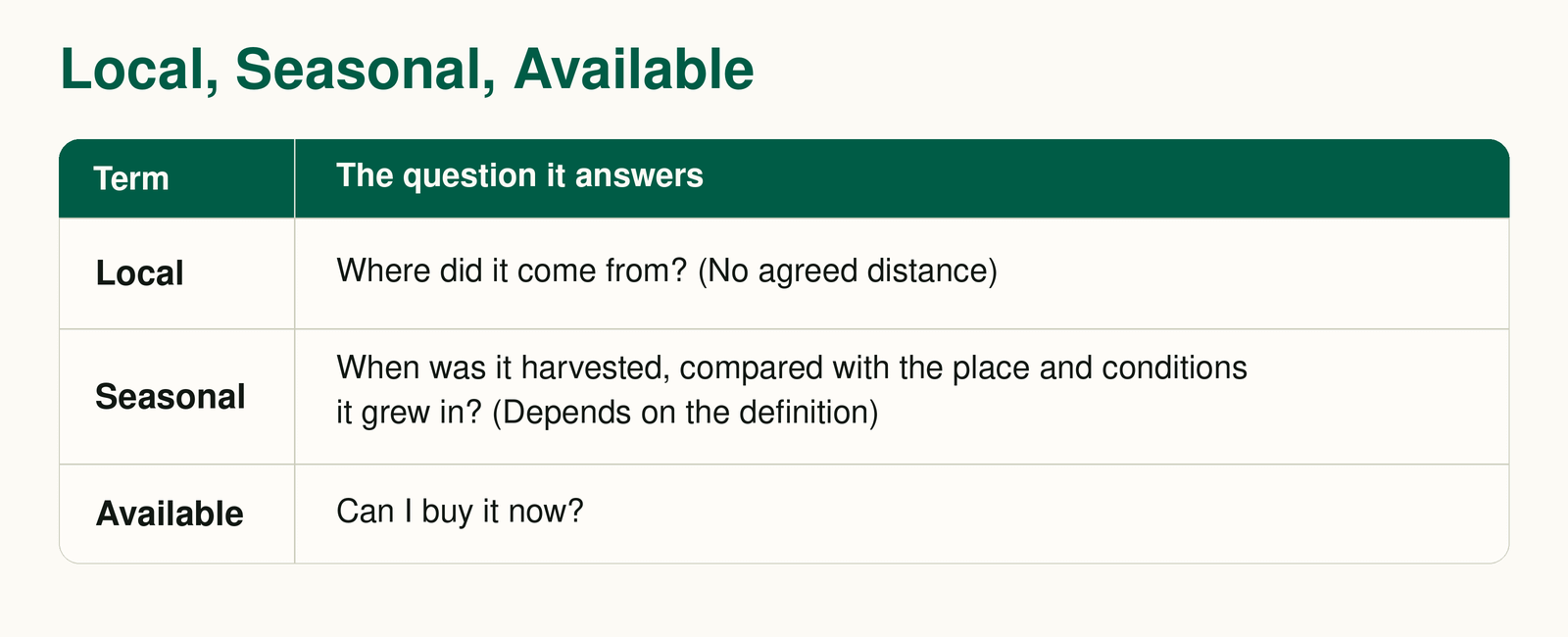
A Nacional fig in late summer is local, seasonal and available.
A South African plum in February is seasonal and available, but not local.
A tunnel tomato in May is local and available but its seasonality is unclear.
I spoke about the long-term storage of apples in Part 1. Apples picked last fall and sold from storage in spring are local and available. By the locally seasonal definition, they aren’t seasonal.
The main issue with all this confusion is the overlapping of usage and inferred definition. For example, “it’s local, so it must be seasonal.”
Availability is the word we see the most but tells us the least. A full display says that you can buy it, not whose growing season produced it.
If none of these three words carry the whole meaning, what would a useful definition need?
What I Mean by In Season
Moving to Portugal didn’t change the fruit as much as it changed my attention.
The Nacional label made me ask where and the short seasons made me notice the when. Seeing the plums come and go didn’t teach me a new season.
They taught me that I never knew what season I was buying.
In season is not a date on the calendar. It also is not a quality guarantee.
It becomes more precise when you can name three things:
Place: where it grew
Harvest window: when it normally matures there
Growing conditions: open field, tunnel, heated greenhouse
A Nacional fig in late summer, a South African plum in February, and a tunnel tomato in May all need these three parts to mean anything.
This is my working interpretation, and not fully settled. A hypothesis that I will continue testing.
Seasonal food is often marketed as healthier or more nutritious.
But “in season” can mean a tunnel tomato, a South African plum or a field-grown fig.
Are they all more nutritious?
What food tells you the season has changed where you live?
Next Part 3: Does seasonal food actually contain more nutrients?
Live well,
Nathan
Educational only, not medical advice. Consult your physician before changing your health, diet, or exercise routine.
SOURCES
Vargas, A. M., de Moura, A. P., Deliza, R., & Cunha, L. M. (2021). “The Role of Local Seasonal Foods in Enhancing Sustainable Food Consumption: A Systematic Literature Review.” Foods, 10(9), 2206. https://doi.org/10.3390/foods10092206
Macdiarmid, J. I. (2014). “Seasonality and dietary requirements: will eating seasonal food contribute to health and environmental sustainability?” Proceedings of the Nutrition Society, 73(3), 368–375. Definitions adapted from DEFRA (2012), as reproduced in this paper. https://doi.org/10.1017/S0029665113003753
Direção-Geral de Agricultura e Desenvolvimento Rural (DGADR). “Ameixa d’Elvas DOP.” Official product description and specification covering the variety, production area, and local name. Product page: https://tradicional.dgadr.gov.pt/pt/cat/frutos-frescos/955-ameixa-d-elvas-dop — Product specification: https://tradicional.dgadr.gov.pt/images/prod_imagens/frescos/docs/CE_ameixa_elvasdoc_ae.pdf
Andrews, N., Coop, L., Stoven, H., Noordijk, H., & Heinrich, A. Vegetable degree-day models: An introduction for farmers and gardeners. Oregon State University Extension Service, EM 9305. https://extension.oregonstate.edu/catalog/em-9305-vegetable-degree-day-models-introduction-farmers-gardeners
Hortgro. A Campaign to Promote South African Stone Fruit in the UK 2023/2024. Reports a November–May plum season, with the overall stone-fruit peak around late January and early February. https://www.hortgro.co.za/wp-content/uploads/docs/2024/08/UK-Marketing-Campaign_stone_fruit_23_24.pdf
Costa, J. M., et al. (2020). “Overview of greenhouse horticulture in Portugal: technology and environment.” Actas Portuguesas de Horticultura, 30, 115–123. https://sapientia.ualg.pt/bitstreams/8112c502-16bd-417f-b5d9-7a8005fb3bc8/download
Weber, C., & Davis, W. V. (2024, June 20). “Greenhouse tomatoes fuel U.S. import growth in fresh tomatoes.” USDA Economic Research Service. Reports the 88% greenhouse-supply figure and the almost-80% cherry/grape import figure for 2023. https://ers.usda.gov/data-products/charts-of-note/109371
Minor, T., Baskins, S., & Bond, J. K. (2019, May 1). “Imported Greenhouse Tomatoes From Mexico Illustrate the Growing Diversity in Fresh-Market Tomatoes.” USDA Economic Research Service, Amber Waves. https://ers.usda.gov/amber-waves/2019/may/imported-greenhouse-tomatoes-from-mexico-illustrate-the-growing-diversity-in-fresh-market-tomatoes
Photo Credits:
Tomato tunnel photograph: Brands and People