

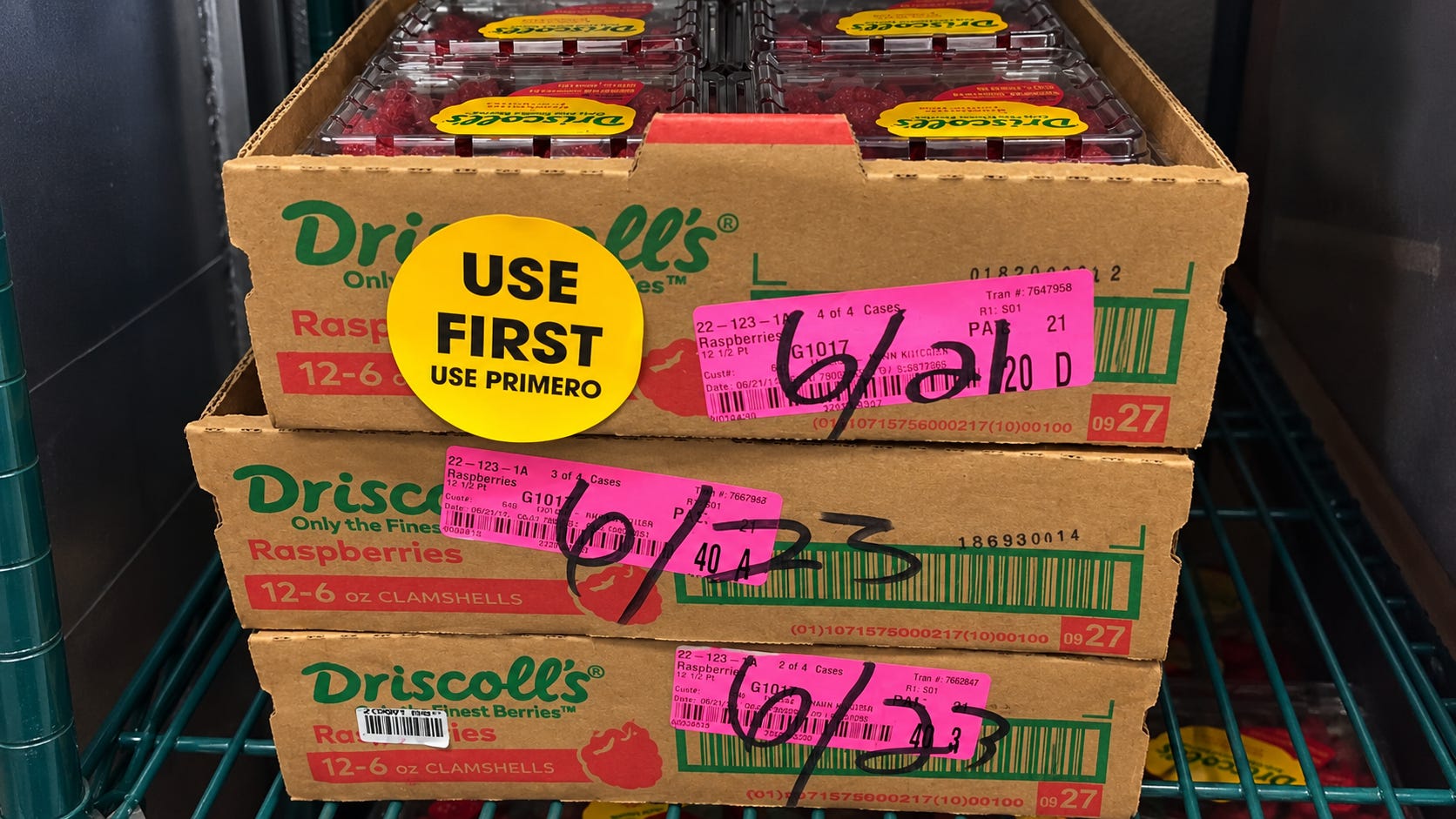
Chef, can you come have a look at this?
Sure. How am I going to use this? We don’t get anything else until Tuesday and we have a large party tonight with this on the menu.
The dock would call me all the time.
I was crazy about the quality of food that was received. I sent food back so many times the warehouse would check with me to ensure it was the proper quality.
The smell, the touch, the color, the blemishes (some good, some bad), the mold forming on the stem. This is already past the use-by date.
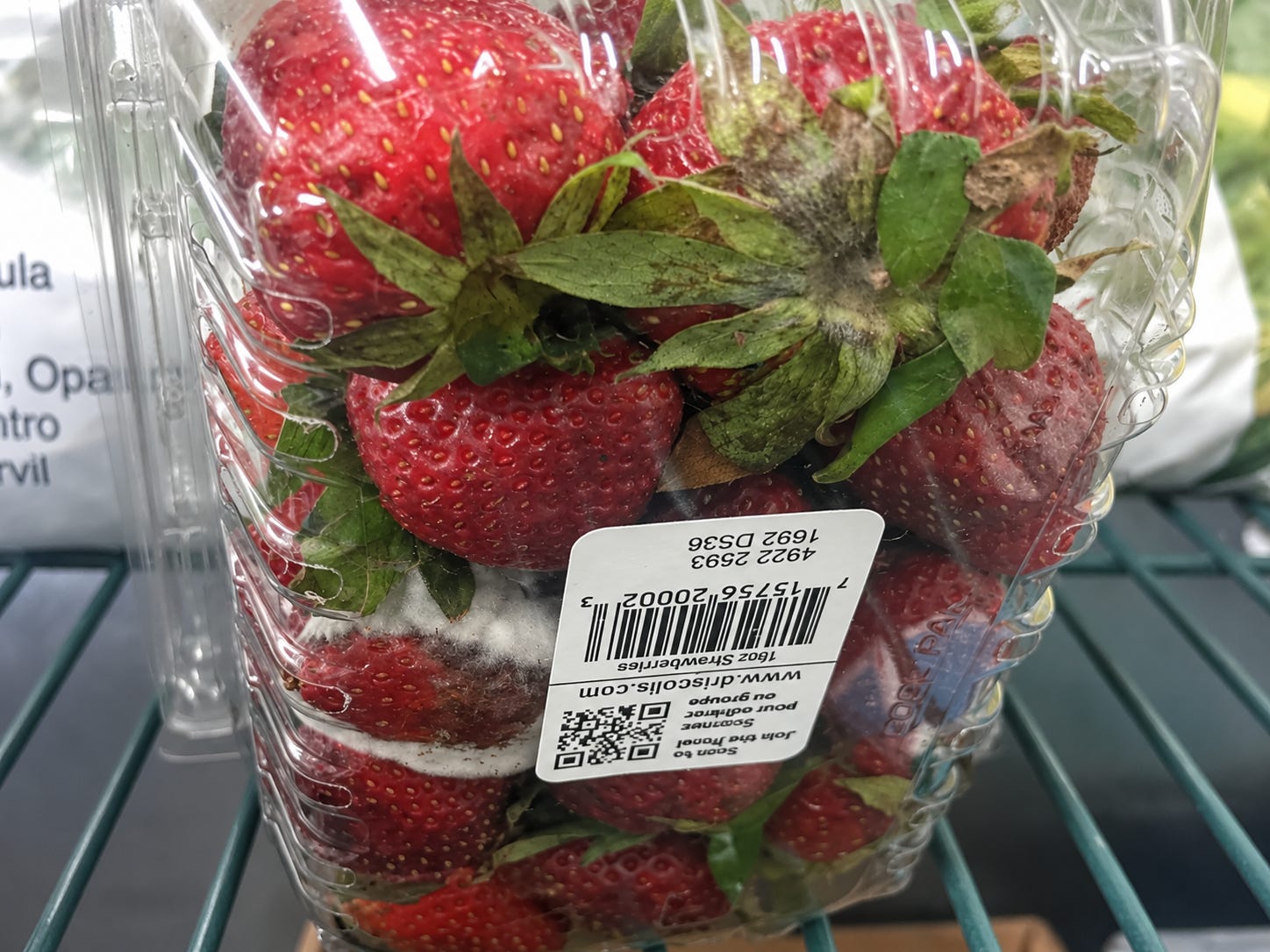
All this scrutiny, and then it is delivered to your restaurant. Or put it in the warehouse cooler to wait for someone to order.
RCV date: the day it was received. The only information you control. That was the day it came into the building. It told me almost nothing that happened before that.
This is the first article in a four-part series about seasonal eating.
Together, we will examine:
Part 1: Whether fresh, frozen, stored or imported is best. (You're here.)
Part 2: What "in season" means in a global food system. (October 22)
Part 3: Whether seasonal produce is actually more nutritious.
Part 4: How much seasonality should influence what we buy and eat.
The goal is not to make shopping more complicated.
It is to separate what seasonality can offer from the claims it cannot support.
Regular essays continue next week. Subscribe free and I’ll send you every one.
Fresh Gives Us a Feeling
FRESH: Recently made, produced, or harvested; not stale or spoiled.1
A definition that gives you a feeling without giving you any information.
To say that food is fresh can vary based on the factors affecting it before you bought it.
Well, it’s not frozen or canned, so it’s fresh. This isn’t the guarantee anyone, especially a chef, is looking for.
It also doesn’t mean it’s local.
When you go to the grocery store, “fresh” sounds like a timeline.
We picture our produce picked on the field and then driven straight to the shelf or display we select it from. Some apples can remain in remarkable quality for up to ten months after harvest in controlled-atmosphere storage.2
In the United States, federal labeling rules define “fresh” this way: generally it means raw and not frozen, thermally processed or preserved. Refrigeration, waxing, approved post-harvest pesticides, mild washes and limited irradiation do not necessarily prevent the term “fresh” from being used.3
A tomato can be picked green and ripen after the harvest. The appearance tells you something useful about the current condition, but little on how they got there.
Fresh gives us a feeling.
It does not give us any of the food’s history.
What Happens After Harvest?
After it is harvested, does it die?
The truth is your broccoli is alive when it reaches your kitchen.
When it’s picked, the water and nutrient supply is cut off, but the cells keep working. Part of this is done through respiration, literally the plant using its stored sugars as energy and taking in oxygen, while releasing carbon dioxide. Some produce also releases ethylene, a plant hormone that accelerates aging and ripening in sensitive fruits and vegetables. That’s why storage of certain foods together makes them decline quickly.4
At the same time, they can be losing water to evaporation.
How quickly this happens depends on the conditions. Warmth usually speeds it up, cooling usually slows it. Dry air wilts it, and a small cut or bruise can make produce lose water faster and shorten the shelf life.
This does not mean that an older apple is devoid of any nutrition.
Different parts of food change at different rates. Vitamin C is more vulnerable during storage, while minerals and fiber are generally more stable.5
Your food may lose some nutrients, but it will still provide plenty that is useful to eat.
The crop, maturity when picked, storage temperature, time, and any processing all affect the final result.
When we refrigerate it, we buy it time. The clock never stops.
What Freezing Changes
We just received two pallets of frozen vegetables.
Let’s spot-check a few and check the quality. Make sure we rotate the freezer before stocking this.
Frozen vegetables are commonly blanched before they are frozen. This helps slow the enzyme activity before freezing. The heating that comes during blanching can reduce some sensitive nutrients, especially vitamin C.6
Freezing slows down further changes that would happen if refrigerated.
This does not stop all decline. Time, temperature fluctuations, freezer burn and poor packaging still matter.
There is no question that freezing changes food. The real question is how those changes compare to what happens to produce sold as “fresh.”
What the Study Found
In 2015, there was a study conducted comparing vitamins in eight fruits and vegetables.7
It tested different vitamins and the fresh and frozen versions at different points during the storage process.
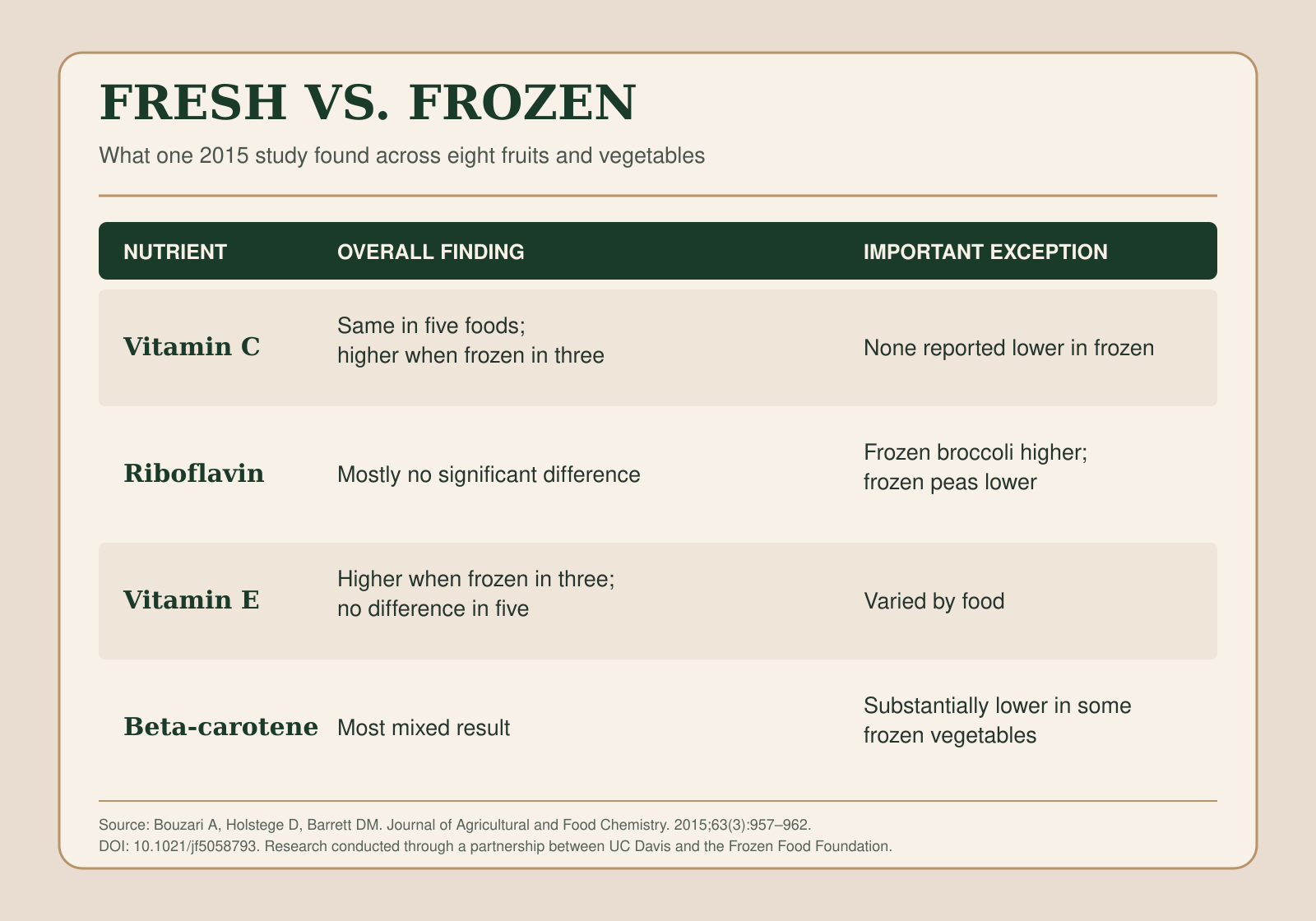
What was found was that frozen was not universally better but generally comparable.
Vitamin C was the same in five of the foods and higher in the frozen for the other three.
Vitamin E was higher in some of the frozen produce, and beta-carotene was lower in others.
A companion paper tested minerals, fiber and phenolics, and the results were comparable in both the frozen and fresh produce tested.8
The studies were not perfect and had some limitations.
Only eight foods were tested and selected nutrients measured. This can’t cover or represent every farm, supply chain, freezer or household. The Frozen Food Foundation partnered with UC Davis on the research. The Foundation is affiliated with the American Frozen Food Institute, so its interest in the findings is relevant when interpreting the results.9
This is not definitive proof that frozen is better.
It does dismantle the assumption that frozen is automatically worse.
Local, Imported, Stored and Frozen
Local
What could be better in terms of freshness?
There are benefits to the flavor and texture based on the product’s proximity.
The transparency of the local farmer who picks their produce and sells it the same morning. A local distributor selling apples and potatoes held in storage.
Both of them can truthfully be called local.
Yes, the supply chain is shorter and more transparent, but the distance doesn’t tell you the condition the food is in.
Imported
Who doesn’t miss their favorite vegetables and fruits out of season?
Imports can offer access to fruits and vegetables outside of the normal season and for larger parts of the year. Produce can be grown under better conditions. When the produce is of good quality, it can be transported and handled well.
With variety also come limitations.
Some produce may be picked before maturity to survive the travel and arrive in saleable condition. During travel, breaks in temperature control, poor humidity management and rough handling can contribute to deterioration. The more delicate the product, the greater chance the product has of losing both taste and/or texture. Citrus, onions and squash fare much better than herbs, berries and ripe tomatoes.
Distance matters, but the quality of harvest and the ability to keep the produce cold during each leg of transport matter much more.
Stored
Is this an oxymoron? How can fresh be stored?
With foods with a short harvest window and the ability to have continued access to them, storage is an alternative.
Storage also helps with price, supply and demand and helps lower food waste.10
Examples would be apples, cabbage and potatoes.
Not every food is suited for this.
They can change texture and flavor and have some nutrient decline. The other issue is the transparency of this storage to you as the consumer. You probably have no idea this is happening, in part because commercial storage can manage temperature, humidity and atmosphere, slowing the respiration and moisture loss.
Food bought after storage doesn’t mean it is spoiled or lacking all nutrition. All it means is that the time and deterioration have been managed.
Frozen
Frozen after harvest. What could preserve that moment better than that?
Freezing produce can slow deterioration quickly, mitigate waste and make portioning easier.
Freezing does change the texture and taste. It can get ice crystals and freezer burn from improper packaging and freezer quality and temperature fluctuations.
Frozen produce does preserve produce well, but its advantages are dependent on its processing, storage and how you utilize it.
Different Journeys, Not Guaranteed Outcomes
Local apples can be stored for months.
Imported berries can arrive quickly by air.
Frozen peas may be processed right next to the field they were grown in.
A fresh tomato may be picked green, treated and ripened en route.
Neither fresh nor frozen can be declared a winner by themselves.
They describe different parts of the journey but not guaranteed outcomes.
Peak or Frozen?
There is no law about using peak or frozen. Here are considerations to make for which one makes sense to you when deciding.
Buy Fresh:
The produce smells, feels and looks excellent
Texture is central to your dish
You intend to eat it soon
You know something about where it came from
It is to be served raw or slightly cooked
Buy Frozen:
Fresh version looks tired, underripe or inconsistent
Food will be cooked, blended or pureed
You only need a small amount of the package
You need to cook quickly in a pinch
Frozen makes it easier to include in the meal
So now that you have all this information, which one should you buy?
Three Questions to Ask
Is the fresh version good?
Check the quality. Examine the color, the firmness, and texture. Smell it, turn it around and give a total assessment. Each time you do this, you develop your ability to answer these questions better.
Does the dish you’re making depend on fresh texture or flavor?
A salad, raw preparation, bowl of berries, or a sliced tomato definitely will. If you are making a soup, puree or smoothie, it may not.
Will you use it before its quality declines?
A veggie eaten is better than one left to spend its last days in your fridge. If the answer is no, frozen may preserve more value and create less waste.
If you trust the store you shop at, let them choose for you. Ask for help. Tell them when you are going to eat it. That will change what you take home.
Run Your Own Receiving Dock
If you want to make better decisions, start inspecting produce a little closer. Just because it says it just arrived doesn’t guarantee it was just picked.
Fresh, frozen, stored and imported are not automatic rankings or hierarchies.
Each one gives one definition of the journey. No category always wins.
Use the three questions above to vastly improve your decisions on the best versions for your situation.
Choose fresh when the quality is unmistakable and the dish demands it.
Choose frozen when fresh quality is poor or the preparation suits frozen.
Imported and stored still may be the best option.
Fresh gives you a feeling, not the food’s complete history.
Judge the product itself, not the label exclusively.
The best choice is the one that best fits each ingredient and the meal you are making.
Every time you purchase produce is a chance to run your own receiving dock.
What is one fruit or vegetable you regularly choose frozen instead of fresh?
Live well,
Nathan
Educational only — not medical advice. Consult your physician before changing your health, diet, or exercise routine.
SOURCES
The American Heritage Dictionary of the English Language, “Fresh,” definition 2a. https://www.ahdictionary.com/word/search.html?q=fresh
Mitcham EJ, Crisosto CH, Kader AA. "Apple (Red Delicious)." Produce Fact Sheet. UC Davis Postharvest Research and Extension Center; 1999. Lists controlled-atmosphere storage potential of up to 10 months, compared with about 6 months in regular air storage. https://postharvest.ucdavis.edu/produce-facts-sheets/apple-red-delicious
U.S. Food and Drug Administration, 21 C.F.R. § 101.95, “‘Fresh,’ ‘freshly frozen,’ ‘fresh frozen,’ ‘frozen fresh.’” https://www.ecfr.gov/current/title-21/chapter-I/subchapter-B/part-101/subpart-F/section-101.95
Boyette M, Simmons C, Merck A, Grieger K. "Chapter 1. Introduction." In: Introduction to the Postharvest Engineering for Fresh Fruits and Vegetables: A Practical Guide for Growers, Packers, Shippers, and Sellers. NC State Extension; 2025. https://content.ces.ncsu.edu/introduction-to-the-postharvest-engineering-for-fresh-fruits-and-vegetables/postharvest-engineering-1-introduction
Rickman JC, Barrett DM, Bruhn CM. “Nutritional Comparison of Fresh, Frozen and Canned Fruits and Vegetables. Part 1: Vitamins C and B and Phenolic Compounds.” Journal of the Science of Food and Agriculture. 2007;87(6):930–944. https://doi.org/10.1002/jsfa.2825. See also Rickman JC, Bruhn CM, Barrett DM. “Part 2: Vitamin A and Carotenoids, Vitamin E, Minerals and Fiber.” Journal of the Science of Food and Agriculture. 2007;87(7):1185–1196. https://doi.org/10.1002/jsfa.2824
Xiao HW, Pan Z, Deng LZ, et al. “Recent Developments and Trends in Thermal Blanching—A Comprehensive Review.” Information Processing in Agriculture. 2017;4(2):101–127. DOI: https://doi.org/10.1016/j.inpa.2017.02.001
Bouzari A, Holstege D, Barrett DM. "Vitamin Retention in Eight Fruits and Vegetables: A Comparison of Refrigerated and Frozen Storage." Journal of Agricultural and Food Chemistry. 2015;63(3):957–962. https://doi.org/10.1021/jf5058793
Bouzari A, Holstege D, Barrett DM. "Mineral, Fiber, and Total Phenolic Retention in Eight Fruits and Vegetables: A Comparison of Refrigerated and Frozen Storage." Journal of Agricultural and Food Chemistry. 2015;63(3):951–956. https://doi.org/10.1021/jf504890k
American Frozen Food Institute, Frozen Food Foundation. "Nutrition Research." Describes the foundation's partnership with UC Davis on the eight-commodity study. https://affi.org/fffoundation/nutrition/
Food and Agriculture Organization of the United Nations. Food Loss Prevention in Perishable Crops, Chapter 4, "Fruits and Vegetables." FAO Agricultural Services Bulletin; 1980. Storage can extend usefulness, ease market gluts, widen year-round selection and may reduce later losses, but cannot reverse damage that occurred before storage. https://www.fao.org/4/s8620e/S8620E0a.htm